Estimation of White Trevally (Decapterus macrosoma) Stock in the Waters of Nusa Laut, Maluku, Indonesia
Abstract
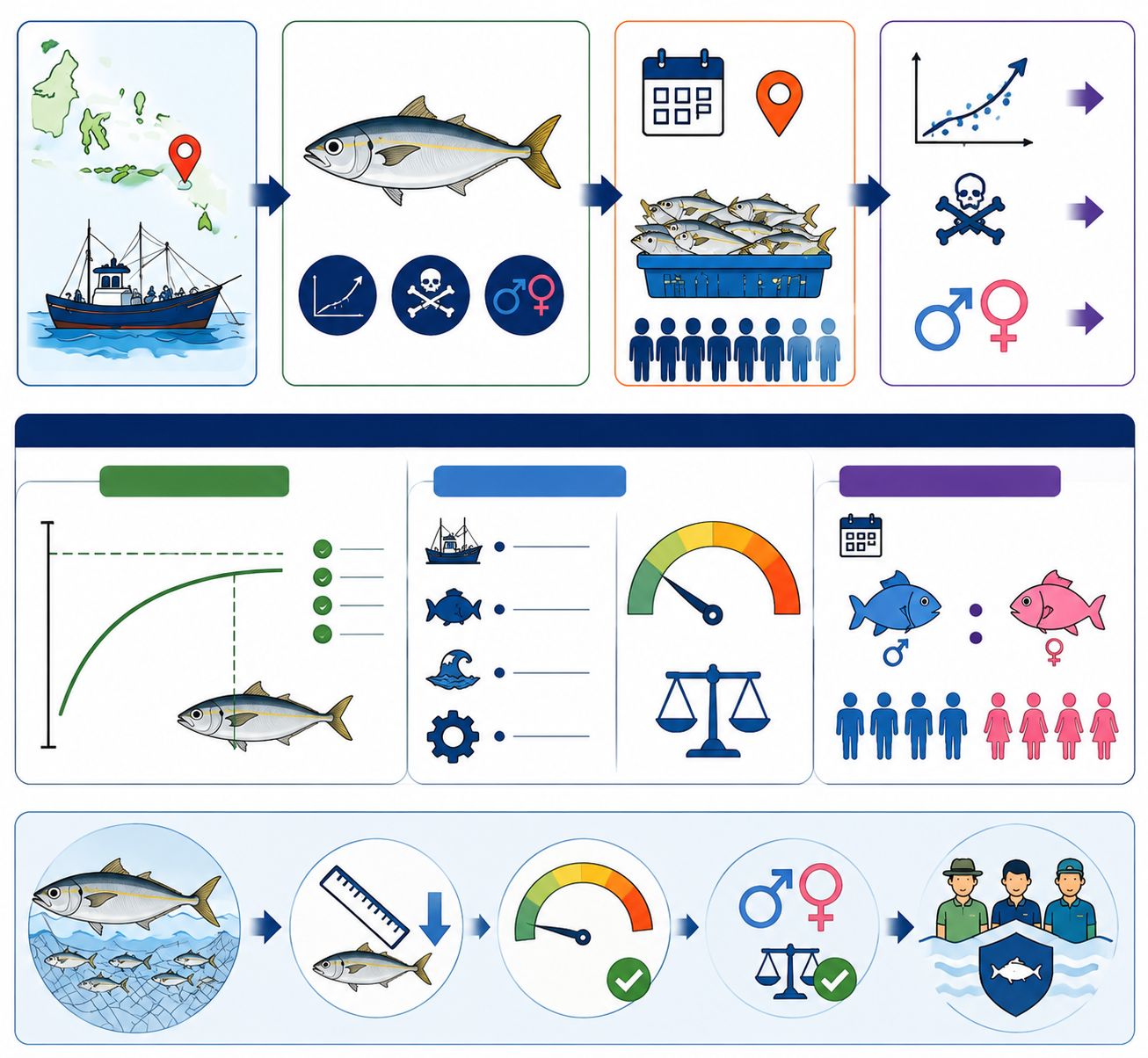
The potential of marine resources from the Banda Sea, particularly the waters of Nusa Laut, represents an important economic aspect for local fishers. Several fishing fleets targeting scad, including mini purse seine vessels, are widely distributed in the area, with continuous exploitation activities occurring every week. This study aimed to analyze the growth pattern, mortality, and sex ratio of white scad (Decapterus macrosoma) in Nusa Laut waters, landed at Arumbai Market, Ambon. The research was conducted using a survey method from January to June 2025, with a total sample of 150 individuals. Data were analyzed based on growth pattern, fish mortality, and sex ratio analyses. The results showed that the asymptotic length (L∞) was estimated at 24.7 cm total length (TL), with a growth coefficient (K) of 0.61 year⁻¹ and a theoretical age at zero length (t₀) of −0.25 year. The fishing mortality (F) value was 0.46 year⁻¹, the total mortality (Z) was 1.80 year⁻¹, and the natural mortality (M) was 1.34 year⁻¹, resulting in an exploitation rate (E) of 0.25. The sex ratio analysis conducted from February to June indicated that the proportion of male and female fish was in a balanced condition, with a ratio of 1:1. Based on the exploitation analysis, the length corresponding to half of the asymptotic length (L∞/2 = 12.35 cm TL) indicated that the captured fish were still relatively small. Therefore, the biological characteristics of white scad caught in Nusa Laut waters, Central Maluku, and landed at Arumbai Market, Ambon City, indicate that the fish are predominantly captured at a small size with a relatively low exploitation level.
References
Ashwin, J., Chhabra, A., & Rao, V. (2026). Using large language models for qualitative analysis can introduce serious bias. Sociological Methods & Research, 55(3), 795-839. https://doi.org/10.1177/00491241251338246
Astuti, M. P., Saputra, S. W., & Taufani, W. T. (2021). Laju Mortalitas dan Tingkat Pemanfaatan Ikan Layang Deles (Decapterus macrosoma) Berdasarkan Data di PPN Pekalongan. Jurnal Harpodon Borneo, 14(1), 15–20. https://doi.org/10.35334/harpodon.v14i1.1891
Flinn, S. A., & Midway, S. R. (2021). Trends in growth modeling in fisheries science. Fishes, 6(1), Article 1. https://doi.org/10.3390/fishes6010001
Froese, R., & Pauly, D. (Eds.). (2024). FishBase. World Wide Web electronic publication. Retrieved from https://www.fishbase.org
Gayanilo, F. C., Jr., Sparre, P., & Pauly, D. (2005). FAO-ICLARM stock assessment tools II (FiSAT II): Revised version—User’s guide (FAO Computerized Information Series Fisheries No. 8). Food and Agriculture Organization of the United Nations.
Hatidja, D., Patty, W., Kekenusa, J. S., Mandagi, S. V., Angmalisang, P. A., Budiman, J., Rogi, R. E. X., Fauzy, A., & Momuat, L. I. (2025). Spatial and temporal analysis of scad fish (Decapterus spp.) catches in the Sulawesi Sea in relation to oceanography parameters using generalized additive models. Egyptian Journal of Aquatic Biology and Fisheries, 29(6), 979–1003. https://doi.org/10.21608/ejabf.2025.389185.5945
Khouw, A. S. (2016). Metode dan Analisa Kuantitatif dalam Bioekologi Laut. Alfabeta.
Kjesbu, O. S., Righton, D., Krüger-Johnsen, M., Thorsen, A., Michalsen, K., Fonn, M., & Witthames, P. R. (2020). Life histories determine divergent population trends for fishes under climate warming. Nature Communications, 11, Article 1712. https://doi.org/10.1038/s41467-020-17937-4
La Ima, T., Pattikawa, J. A., & Tuapetel, F. (2023). Manajemen Perikanan Tangkap Ikan Layang (Decapterus macrosoma) di Perairan Banda Berbasis Aspek Biologi. Amanisal: Jurnal Teknologi dan Manajemen Perikanan Tangkap, 12(1), 14–26. https://doi.org/10.30598/amanisalv12i1p14-26
Lee, L., Atkinson, D., Hirst, A. G., & Cornell, S. J. (2020). A new framework for growth curve fitting based on the von Bertalanffy growth function. Scientific Reports, 10, Article 7953. https://doi.org/10.1038/s41598-020-64839-y
Leiwakabessy, B., Tupamahu, A., & Tuapetel, F. (2021). Rantai Pasok Ikan Layang (Decapterus spp.) di Kota Ambon. PAPALELE: Jurnal Penelitian Sosial Ekonomi Perikanan dan Kelautan, 5(1), 28–38. https://doi.org/10.30598/papalele.2021.5.1.28
Marpaung, S., Prayogo, T., Yati, E., Purwanto, A. D., Nandika, M. R., Domiri, D. D., & Kushardono, D. (2022). Analisis Karakteristik Net Primary Productivity dan Klorofil-a di Laut Banda dan Sekitarnya. Jurnal Ilmu dan Teknologi Kelautan Tropis, 14(1), 31–46. https://doi.org/10.29244/jitkt.v14i1.36757
Nuryadi, Astuti, T. D., Utami, E. S., & Budiantara, M. (2017). Dasar-Dasar Statistik Penelitian. Sibuku Media.
Pattikawa, J. A., Tetelepta, J. M. S., Ongkers, O. T. S., Uneputty, P. A., & Lewerissa, H. (2017). Size distribution, length-weight relationship and age group of Decapterus macrosoma in eastern waters of Ambon Island, Indonesia. AACL Bioflux, 10(4), 969–976.
Pauly, D. (1983). Some simple methods for the assessment of tropical fish stocks (FAO Fisheries Technical Paper No. 234). Food and Agriculture Organization of the United Nations.
Sari, W. K., Utami, R., Aisyah, B. N., Setyohadi, D., & Lelono, T. D. (2024). Karakteristik Biologi dan Potensi Sumberdaya Ikan Layang Deles (Decapterus macrosoma) di Perairan Prigi Jawa Timur. JFMR (Journal of Fisheries and Marine Research, 8)(3), 159–165. https://doi.org/10.21776/ub.jfmr.2024.008.03.15
Septiyaningrum, I., Tumulyadi, A., & Setyohadi, D. (2023). Analisis Parameter Dinamika Populasi Sumber Daya Ikan Layang Deles (Decapterus macrosoma) yang Didaratkan di TPI Pondokdadap. Prosiding Seminar Nasional Hasil Penelitian Kelautan dan Perikanan, 1(1), 101–112.
Soukotta, I. V. T., Moniharapon, D. L., Supusepa, J., & Tuapetel, F. (2024a). Biologi Populasi Ikan Layang Putih (Decapterus macrosoma) yang Didaratkan di Desa Waai, Maluku Tengah. TRITON: Jurnal Manajemen Sumberdaya Perairan, 20(2), 88–97. https://doi.org/10.30598/TRITONvol20issue2page88-97
Soukotta, I. V. T., Supusepa, J., & Moniharapon, D. L. (2024b). Kajian Kondisi Stok Ikan Layang (Decapterus macrosoma) di Perairan Laut Banda Utara, Maluku. Journal of Coastal and Deep Sea, 2(1), 59–67. https://doi.org/10.30598/jcds.v2i1.13519
Sparre, P., & Venema, S. C. (1998). Introduction to tropical fish stock assessment: Part 1. Manual (FAO Fisheries Technical Paper No. 306/1, Rev. 2). Food and Agriculture Organization of the United Nations.
Syahrizal, H., & Jailani, M. S. (2023). Jenis-Jenis Penelitian dalam Penelitian Kuantitatif dan Kualitatif. QOSIM: Jurnal Pendidikan, Sosial & Humaniora, 1(1), 13–23. https://doi.org/10.61104/jq.v1i1.49
Tangke, U., & Talib, A. (2023). Kajian Kondisi Stok Ikan Layang (Decapterus sp.) di Perairan Pulau Ternate. Agrikan: Jurnal Agribisnis Perikanan, 16(1), 192–199. https://doi.org/10.52046/agrikan.v16i1.192
Copyright (c) 2026 Habib Harlino Rofi Latuconsina, Imanuel Villian Trayanta Soukotta, Fahrul Rozy Fakaubun, Wildan Tino, Milyan Uli Latue, Muhammad Fahrul Barcinta, Domey Moniharapon

This work is licensed under a Creative Commons Attribution-ShareAlike 4.0 International License.
Copyright on articles was retained by the respective author(s) without restrictions. The author grants the journal its first publication rights with the work simultaneously licensed under the Creative Commons Attribution-ShareAlike 4.0 International (CC BY-SA) license. This means anyone is free to copy, transform, or redistribute articles for any lawful purpose in any medium, provided they give appropriate attribution to the original author(s).