Seagrass Community in the Coastal Waters of Hitalawa Beach, Negeri Oma, Indonesia
Abstract
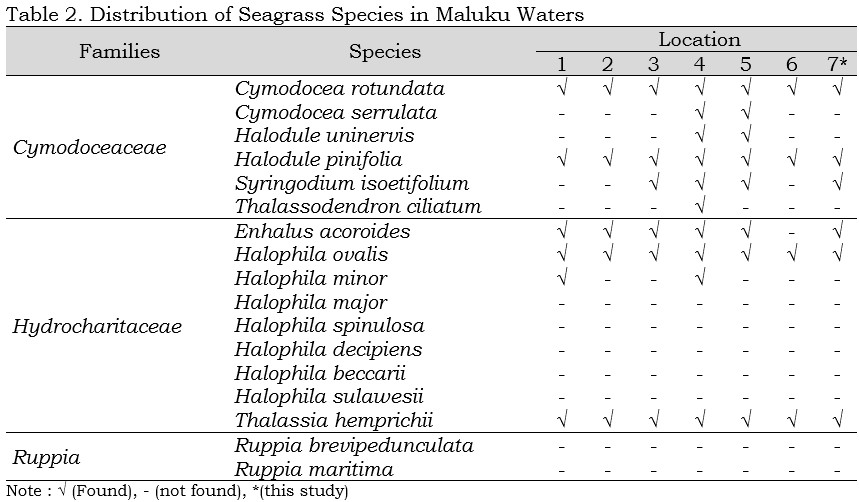
The limited data and information on seagrass ecosystems in Negeri Oma provided the basis for this study. The lack of previous studies offers an opportunity to examine the ecological potential of seagrass more comprehensively and to contribute to the conservation and sustainable management of coastal resources. This study aimed to analyze the species composition and description of seagrass, density and relative density, as well as frequency of occurrence and relative frequency of seagrass species in the coastal waters of Hitalawa Beach, Negeri Oma. The study employed a line transect–quadrat method, consisting of six transects with a total of 30 quadrats. Six seagrass species were recorded, namely Cymodocea rotundata, Halodule pinifolia, Syringodium isoetifolium, Enhalus acoroides, Halophila ovalis, and Thalassia hemprichii. The overall seagrass density reached 89.55 shoots/m², placing the seagrass condition at Hitalawa Beach in scale category 3, namely moderately dense, with a density range of 75–125 shoots/m². The highest frequency of occurrence was recorded for T. hemprichii, which was found in most of the observation plots. Water temperature and salinity across the six transects ranged from 31.2–32.5°C and 27.7–31‰, respectively. The findings indicate that the coastal waters of Hitalawa Beach support a relatively diverse seagrass community with moderately dense seagrass conditions. This study provides updated baseline information on the condition of seagrass beds in the area and may support future coastal resource conservation and management efforts.
References
Fortes, M. D., Ooi, J. L. S., Tan, Y. M., Prathep, A., Bujang, J. S., & Yaakub, S. M. (2018). Seagrass in Southeast Asia: a review of status and knowledge gaps, and a road map for conservation. Botanica Marina, 61(3), 269–288. https://doi.org/10.1515/bot-2018-0008
Gosari, B. A. J., & Haris, A. (2012). Studi Kerapatan dan Penutupan Jenis Lamun di Kepulauan Spermonde. Torani: Jurnal Ilmu Kelautan dan Perikanan. 22(3), 156–162. https://fileserver-az.core.ac.uk/download/pdf/25490826.pdf
Hemminga, M. A., & Duarte, C. M. (2000). Seagrass ecology. Cambridge University Press.
Hetharia, J. V. T., Prartono, T., Koropitan, A. F., & Tapilatu, Y. (2024). The potential of seagrass ecosystems in Waai and Liang coastal waters on Ambon Island as carbon storage sites. IOP Conference Series: Earth and Environmental Science, 1329(1), Article 012006. https://doi.org/10.1088/1755-1315/1329/1/012006
Hidayat, M., Ruswahyuni, R., & Widyorini, N. (2014). Analisis Laju Sedimentasi di Daerah Padang Lamun dengan Tingkat Kerapatan Berbeda di Pulau Panjang, Jepara. Management of Aquatic Resources Journal (MAQUARES), 3(3), 73–79. https://doi.org/10.14710/marj.v3i3.5624
Ihwani, S., Al Idrus, A., & Mertha, I. G. (2023). Conditions of Seagrass Ecosystems in Gili Sulat Waters, Sambelia District, East Lombok Regency in 2022. Jurnal Biologi Tropis, 23(2), 191–197. https://doi.org/10.29303/jbt.v23i2.4785
Irawan, A., & Nganro, N. R. (2016). Distribution of seagrasses in Inner Ambon Bay. Jurnal Ilmu dan Teknologi Kelautan Tropis, 8(1), 99–114. https://doi.org/10.29244/jitkt.v8i1.12499
Krisye, K., Rahman, R., Fendjalang, S. N., & Sirajuddin, N. T. (2023). Jenis dan Tutupan Lamun di Perairan Pulau Maginti, Kabupaten Muna Barat, Sulawesi Tenggara. Grouper: Jurnal Ilmiah Perikanan, 14(1), 24–28. https://doi.org/10.30736/grouper.v14i1.149
Larasati, R. F., Jaya, M. M., Putra, A., Djari, A. A., Sako, K., Khairunnisa, A., Jatayu, D., Aini, S., & Suriadin, H. (2022). Keanekaragaman, Kerapatan Dan Penutupan Jenis Lamun Di Pantai Kastela, Ternate Selatan, Maluku Utara. Journal of Indonesian Tropical Fisheries, 5(2), 162–178. https://doi.org/10.33096/joint-fish.v5i2.128
Lanyon, J. (1986). Guide to the identification of seagrasses in the Great Barrier Reef region. Great Barrier Reef Marine Park Authority.
Lefaan, P. T., Peday, M., Duwit, B., Yoku, S. N., Orisu, D., Baab, Y., Manumpil, A. W., Mardiyadi, Z., Manangkalangi, E., & Sembel, L. (2023). Kepadatan, Karakter Morfologi, dan Pertumbuhan Lamun Cymodocea rotundata di Pantai Yankarwar, Manokwari, Papua Barat: Apakah ada perbedaan diantara Zona Intertidal? Jurnal Perikanan Pantura (JPP), 6(1), 315–332. https://doi.org/10.30587/jpp.v6i1.5367
Miftahuddin, M. F., Muzani., Hardianto, B., Ramadhita, N. P., & Widyarini, S. (2020). Artikel Pengaruh Lamun Terhadap Kehidupan Ikan di Perairan Pulau Pramuka, Kep. Seribu. JURNAL GEOGRAFI Geografi dan Pengajarannya, 18(1), 27–42. https://doi.org/10.26740/jggp.v18n1.p27-42
Muhammad, S. H., Alwi, D., & Fang, M. (2021). Komposisi dan Keanekaragaman Jenis Lamun di Perairan Desa Mandiri Kabupaten Pulau Morotai. Aurelia Journal, 3(1), 73–81. https://doi.org/10.15578/aj.v3i1.10513
Nanlohy, H., & Timisela, N. S. (2017). Tata Kelola pemanfaatan Sumberdaya Perikanan di Kepulauan Kei Kecil, Kabupaten Maluku Tenggara. TRITON: Jurnal Manajemen Sumberdaya Perairan, 13(2), 79–84.
Odum, E. P. (1993). Dasar-Dasar Ekologi. Edisi Ketiga. Gadja Mada University Press; Yogyakarta.
Oktari, M., Amin, B., & Efriyeldi, E. (2023). Analysis of carbon stock in seagrass Cymodocea rotundata in Tuapejat Waters, Mentawai Island District. Asian Journal of Aquatic Sciences, 6(1), 62–67.
Pasanea K., Lokolloa, F. F., Rahmana, J. S., Kalaya, D. E., & Hulopib, M. (2024). Asosisasi Inter-Spesies Lamun di Perairan Pulau Maginti Sulawesi Tenggara. Journal of Coastal and Deep Sea: Juni, 2(1), 37–43. https://doi.org/10.30598/jcds.v2i1.13562
Purnomo, H. K., Yusniawati, Y., Putrika, A., Handayani. W., & Yasman. (2017). Keanekaragaman Spesies Lamun pada beberapa Ekosistem Padang Lamun di Kawasan Taman Nasional Bali Barat. Prosiding Seminar Nasional Masyarakat Biodiversiti Indonesia, 3(2), 236–240. https://doi.org/10.13057/psnmbi/m030213
Rahmawati, S., Irawan, A., Supriyadi, I. H., & Azkab, M. H. (2014). Panduan Monitoring Padang Lamun. Pusat Penelitian Oseanografi Lembaga Ilmu Pengetahuan Indonesia. Jakarta; COREMAP CTI LIPI, 37.
Rumakur, S. (2017). Persen Penutupan Jenis Lamun di Perairan Pantai Negeri Oma, Pulau Haruku, Maluku Tengah [Undergraduate thesis, Universitas Pattimura]. Fakultas Perikanan dan Ilmu Kelautan, Universitas Pattimura, Ambon.
Short, F., Carruthers, T., Dennison, W., & Waycott, M. (2007). Global seagrass distribution and diversity: a bioregional model. Journal of experimental marine biology and ecology, 350(1-2), 3–20. https://doi.org/10.1016/j.jembe.2007.06.012
Tuapattinaya, P. M., & Kurnia, T. S. (2021). Keragaman Fenetik Jenis Lamun Di Perairan Pantai Pulau Ambon Berdasarkan Morfometrik Dan Meristik. Biosel Biology Science and Education, 10(2), 129–137. https://doi.org/10.33477/bs.v10i2.2006
Uneputty, P. A., Haumahu, S., & Mamesah, J. A. (2023). Pelestarian Sumber Daya dan Lingkungan Pesisir dan Laut. Open Community Service Journal, 2(2), 84–90. https://doi.org/10.33292/ocsj.v2i2.40
Copyright (c) 2026 Gilvano Siahaya, Frijona Fabiola Lokollo, Imanuel Villian Trayanta Soukotta, Frederick Rijoly, Krisye Pasanea

This work is licensed under a Creative Commons Attribution-ShareAlike 4.0 International License.
Copyright on articles was retained by the respective author(s) without restrictions. The author grants the journal its first publication rights with the work simultaneously licensed under the Creative Commons Attribution-ShareAlike 4.0 International (CC BY-SA) license. This means anyone is free to copy, transform, or redistribute articles for any lawful purpose in any medium, provided they give appropriate attribution to the original author(s).