Marine Macro-Debris Pollution on the Coast of Negeri Haruku Village
Abstract
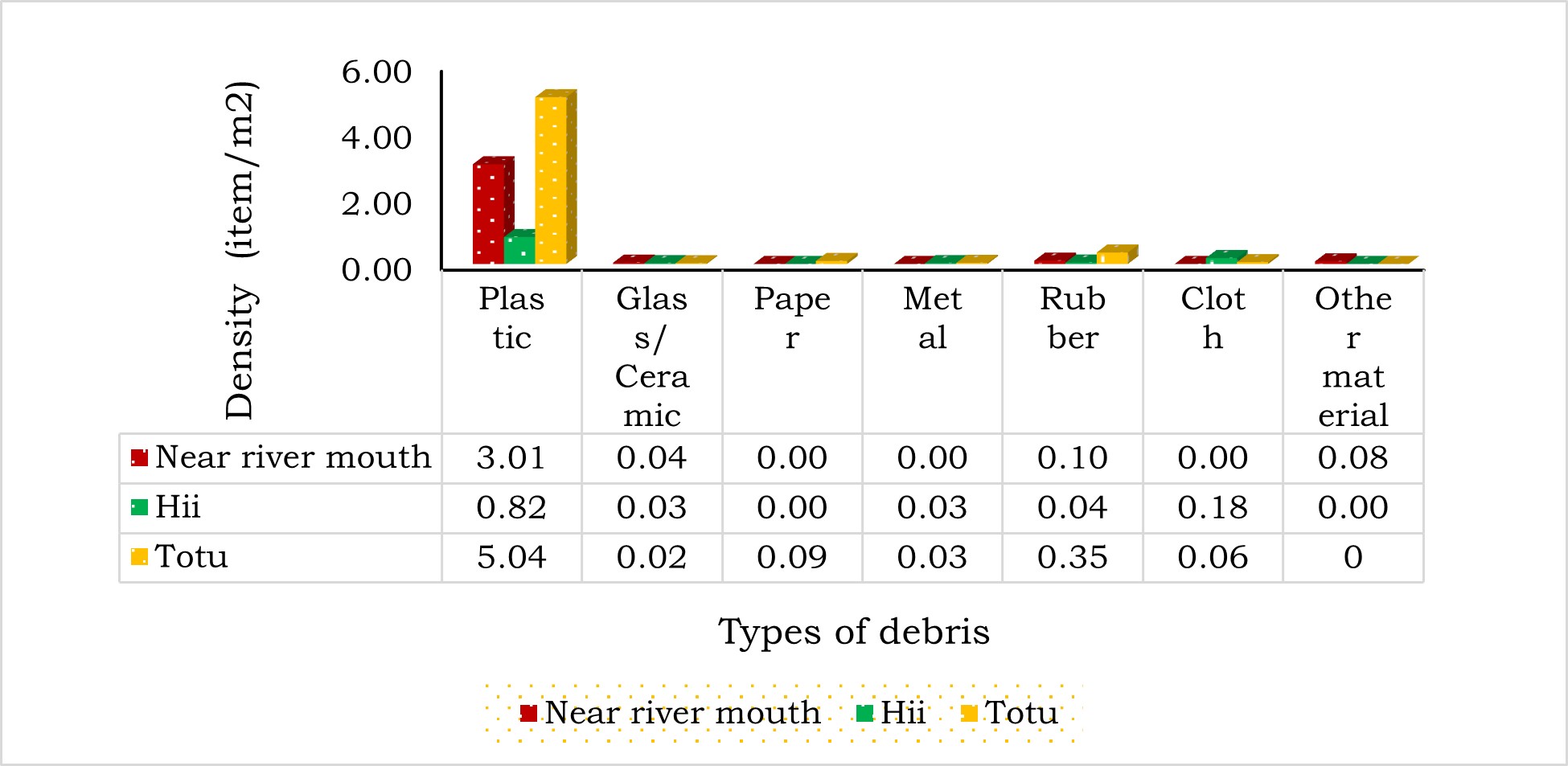
Marine debris is an environmental issue of both national and global concern, particularly marine macro-debris. This study was conducted to determine the level of marine macro-debris pollution along the coast of Negeri Haruku village. Data were collected at three sites considered representative of the Negeri Haruku coastline. A 100-m shoreline transect was used for data collection and divided into 20 segments, from which five segments were randomly selected for sampling. The Clean Coast Index (CCI) was calculated to assess beach cleanliness, while the Plastic Abundance Index (PAI) was used to measure the proportion of plastic debris relative to the total amount of beach debris. The results showed that plastic debris dominated other debris types at all observation sites. This was reflected in the PAI values, namely 4.82 at the site near the river mouth, indicating high plastic density; 1.51 at Hii Beach, indicating moderate plastic density; and 6.09 at Totu Beach, indicating high plastic density. Totu Beach had the highest CCI value of 22.2, indicating a very dirty condition, while the site near the river mouth had a CCI value of 12.6, indicating a dirty condition. In contrast, Hii Beach was classified as clean, with a CCI value of 3.82. A paradoxical pattern was also observed in this study: even at a site with no apparent human activity, debris density was higher (5.55 ± 0.77 items/m²) than at the other two sites. This suggests that the debris may have originated from other locations and been transported by ocean currents. Based on the Clean Coast Index, only Hii Beach was classified as clean, whereas the site near the river mouth and Totu Beach were classified as dirty.
References
Alkalay, R., Pasternak, G., & Zask, A. (2007). Clean-coast index—A new approach for beach cleanliness assessment. Ocean & Coastal Management, 50(5–6), 352–362. https://doi.org/10.1016/j.ocecoaman.2006.10.002
Allsopp, M., Walters, A., Santillo, D., & Johnston, P. (2006). Plastic debris in the world’s oceans. Greenpeace, Amsterdam.
Depledge, M. H., Galgani, F., Panti, C., Caliani, I., Casini, S., & Fossi, M. C. (2013). Plastic litter in the sea. Marine environmental research, 92, 279–281. https://doi.org/10.1016/j.marenvres.2013.10.002
Díaz-Torres, E. R., Ortega-Ortiz, C. D., Silva-Iñiguez, L., Nene-Preciado, A., & Orozco, E. T. (2017). Floating marine debris in waters of the Mexican Central Pacific. Marine pollution bulletin, 115(1-2), 225–232. https://doi.org/10.1016/j.marpolbul.2016.11.065
Eriksen, M., Lebreton, L. C. M., Carson, H. S., Thiel, M., Moore, C. J., Borerro, J. C., Galgani, F., Ryan, P. G., & Reisser, J. (2014). Plastic pollution in the world's oceans: more than 5 trillion plastic pieces weighing over 250,000 tons afloat at sea. PloS one, 9(12), e111913. https://doi.org/10.1371/journal.pone.0111913
Galgani, F., Oosterbaan, L., Poitou, I., Hanke, G., Thompson, R., Amato, E., Janssen, C., Galgani, F., Fleet, D., Franeker, J. Van, Katsanevakis, S., & Maes, T. (2010). Marine Strategy Framework Directive: Task Group 10 Report Marine Litter. In Group (Issue 31210). https://doi.org/10.2788/86941
Hendrawan, I. G., Pamungkas, P. B. P., Adibhusana, M. N., Maharta, I. P. R. F., Saraswati, N. L. G. R. A., Wilcox, C., & Hardesty, B. D. (2023). Characteristics and distribution of stranded plastic pollution in Bali conservation areas. Marine Pollution Bulletin, 197, 115770. https://doi.org/10.1016/j.marpolbul.2023.115770
Hinojosa, I. A., & Thiel, M. (2009). Floating marine debris in fjords, gulfs and channels of southern Chile. Marine pollution bulletin, 58(3), 341–350. https://doi.org/10.1016/j.marpolbul.2008.10.020
Horton, A. A. (Ed.). (2023). Plastic pollution in the global ocean. World Scientific. https://doi.org/10.1142/12912
Kementerian Lingkungan Hidup dan Lingkungan. (2017). Pemantauan Sampah Laut Indonesia Tahun 2017. Jakarta; KLHK.
Lavers, J. L., & Bond, A. L. (2017). Exceptional and rapid accumulation of anthropogenic debris on one of the world’s most remote and pristine islands. Proceedings of the National Academy of Sciences, 114(23), 6052–6055. https://doi.org/10.1073/pnas.1619818114
Law, K. L. (2017). Plastics in the marine environment. Annual review of marine science, 9, 205–229. https://doi.org/10.1146/annurev-marine-010816-060409
Lippiatt, S., Opfer, S., & Arthur, C. (2013). Marine Debris Monitoring and Assessment. NOAA Technical Memorandum, NOS-OR&R-46, 88. http://marinedebris.noaa.gov/sites/default/files/Lippiatt_et_al_2013.pdf
Nelms, S. E., Coombes, C., Foster, L. C., Galloway, T. S., Godley, B. J., Lindeque, P. K., & Witt, M. J. (2017). Marine anthropogenic litter on British beaches: a 10-year nationwide assessment using citizen science data. Science of the Total Environment, 579, 1399–1409.https://doi.org/10.1016/j.scitotenv.2016.11.137
Noya, Y. A., & Tuahatu, J. W. (2021). Kepadatan dan Pola Transport Sampah Laut Terapung di Pesisir Barat Perairan Teluk Ambon Luar. Jurnal Penelitian Sains, 23(1), 19–27. https://doi.org/10.56064/jps.v23i1.594
Rahim, S., Widayati, W., Analuddin, K., Saleh, F., Alfirman, & Sahar, S. (2020). Spatial distribution of marine debris pollution in mangrove-estuaries ecosystem of Kendari Bay. IOP Conference Series: Earth and Environmental Science, 412(1), Article 012006. https://doi.org/10.1088/1755-1315/412/1/012006
Rahmayanti, F., Diana, F., Najmi, N., Riani, E., Yulianto, G., & Munandar, M. (2020). Analisis Kelimpahan, Komposisi Dan Sumber Sampah Laut: Studi Kasus Pada Pantai Kuala Batu Desa Pulau Kayu Kabupaten Aceh Barat Daya. Jurnal Laot Ilmu Kelautan, 2(1), 49–59. https://doi.org/10.35308/jlaot.v2i1.2361
Rangel-Buitrago, N., Barría-Herrera, J., Vergara-Cortés, H., Contreras-López, M., & Agredano, R. (2020a). A snapshot of the litter problem along the Viña del Mar-Concón coastal strip, Valparaíso region, Chile. Marine pollution bulletin, 160, 111524. https://doi.org/10.1016/j.marpolbul.2020.111524
Rangel-Buitrago, N., Velez-Mendoza, A., Gracia, A., & Neal, W. J. (2020b). The impact of anthropogenic litter on Colombia's central Caribbean beaches. Marine Pollution Bulletin, 152, 110909. https://doi.org/10.1016/j.marpolbul.2020.110909
Ribic, C. A., Sheavly, S. B., Rugg, D. J., & Erdmann, E. S. (2012). Trends in marine debris along the U.S. Pacific Coast and Hawai’i 1998-2007. Marine Pollution Bulletin, 64(5), 994–1004. https://doi.org/10.1016/j.marpolbul.2012.02.008
Schernewski, G., Escobar-Sánchez, G., Wandersee, P., Lange, X., Haseler, M., & Nassour, A. (2023). Marine Macro-Litter (Plastic) Pollution of European and African Marina and City Port Sea Floors. Applied Sciences, 13(20), 11424. https://doi.org/10.3390/app132011424
Sigler, M. (2014). The effects of plastic pollution on aquatic wildlife: current situations and future solutions. Water, Air, & Soil Pollution, 225(11), 2184. https://doi.org/10.1007/s11270-014-2184-6
Smith, S. D., & Bernal, E. (2021). Quantifying mismanaged waste in a small Balinese coastal village: Comparisons of standing stock in different habitats. Ocean & coastal management, 202, 105433. https://doi.org/10.1016/j.ocecoaman.2020.105433
Tangaroa Blue. (2016). Marine Debris Identification Manual. http://www.tangaroablue.org/sea-store/clean-up-materials-resources/marine-debris-identification-manual.html
Terzi, Y., & Seyhan, K. (2017). Seasonal and spatial variations of marine litter on the south-eastern Black Sea coast. Marine pollution bulletin, 120(1-2), 154–158. https://doi.org/10.1016/j.marpolbul.2017.04.041
Tuahatu, J. W., Kalay, D. E., & Leatemia, B. M. (2022). Kepadatan Sampah Plastik Pada Muara Sungai Di Perairan Teluk Ambon. Seminar Nasional Tahunan XIX Hasil Penelitian Perikanan dan Kelautan Tahun 2022 (Semnaskan-UGM XIX), 245–250.
Tuahatu, J. W., Noya, Y. A., & Manuputty, G. D. (2020). Plastic pollution on the beaches of outer Ambon Bay. IOP Conference Series: Earth and Environmental Science, 584(1), Article 012058. https://doi.org/10.1088/1755-1315/584/1/012058
Tuahatu, J. W., & Tuhumury, N. C. (2022). Sampah Laut yang Terdampar di Pesisir Pantai Hative Besar Pada Musim Peralihan 1. TRITON: Jurnal Manajemen Sumberdaya Perairan, 18(1), 47–54. https://doi.org/10.30598/tritonvol18issue1page47-54
Tuhumury, N. C., & Kaliky, I. (2019). Identifikasi Sampah Pesisir di Desa Rumah Tiga Kota Ambon. TRITON: Jurnal Manajemen Sumberdaya Perairan, 15(1), 30–39. https://doi.org/10.30598/TRITONvol15issue1page30-39
Tuhumury, N. C., & Sahetapy, J. M. (2022). Analisis Bentuk dan Kelimpahan Mikroplastik Pada Ikan Budidaya dan Air di Perairan Teluk Ambon. Jurnal Grouper, 13(1), 18–25. https://doi.org/10.30736/grouper.v13i1.106
United Nations Environment Programme. (2009). Marine Litter: A Global Challenge. Nairobi; UNEP (United Nations Environment Programme).
United Nations Environment Programme & National Oceanic and Atmospheric Administration. (2012). The Honolulu Strategy – A Global Framework for Prevention and Management of Marine Debris. Retrieved from http://www.unep.org/gpa/documents/publications/honolulustrategy.pdf
United Nations Environment Programme. (2016). Marine Litter Vital Graphics. United Nations Environment Programme and GRID-Arendal. Nairobi and Arendal.
Veiga, J. M., Fleet, D., Kinsey, S., Nilsson, P., Vlachogianni, T., Werner, S., Galgani, F., Thompson, R. C., Dagevos, J., Gago, J., Sobral, P., & Cronin, R. (2016). Identifying sources of marine litter: MSFD GES TG marine litter thematic report (EUR 28309 EN). Publications Office of the European Union. https://doi.org/10.2788/018068
Vlachogianni, T., Fortibuoni, T., Ronchi, F., Zeri, C., Mazziotti, C., Tutman, P., Varezić, D. B., Palatinus, A., Trdan, Š., Peterlin, M., Mandić, M., Markovic, O., Prvan, M., Kaberi, H., Prevenios, M., Kolitari, J., Kroqi, G., Fusco, M., Kalampokis, E., & Scoullos, M. (2018). Marine litter on the beaches of the Adriatic and Ionian Seas: An assessment of their abundance, composition and sources. Marine pollution bulletin, 131, 745–756. https://doi.org/10.1016/j.marpolbul.2018.05.006
Copyright (c) 2026 Juliana Wilmiena Tuahatu, Gratia Dolores Manuputty, Marlin Chrisye Wattimena, Fahrul Rozy Fakaubun

This work is licensed under a Creative Commons Attribution-ShareAlike 4.0 International License.
Copyright on articles was retained by the respective author(s) without restrictions. The author grants the journal its first publication rights with the work simultaneously licensed under the Creative Commons Attribution-ShareAlike 4.0 International (CC BY-SA) license. This means anyone is free to copy, transform, or redistribute articles for any lawful purpose in any medium, provided they give appropriate attribution to the original author(s).