Contribution of Fishermen’s Wives to Household Income in Kawal Village, Bintan Regency
Abstract
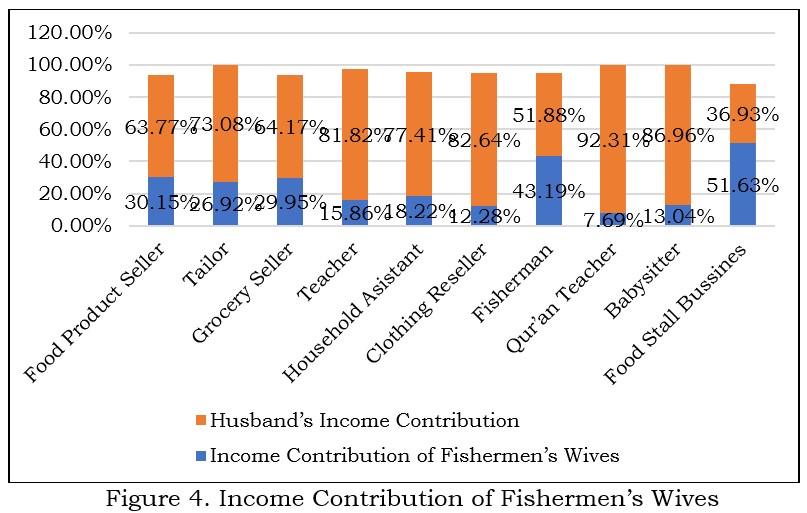
Fisher households are coastal community groups that depend heavily on unpredictable marine catches, resulting in fluctuating household income. This condition encourages fishermen’s wives to participate in economic activities to help meet household needs. This study aimed to analyze the contribution of fishermen’s wives to household income in Kawal Urban Village, Bintan Regency. A quantitative descriptive method was employed, with purposive sampling used to select respondents. Data were analyzed by calculating total costs, total revenue, total income, and the percentage contribution of wives’ income to household income. The results showed that fishermen’s wives engaged in ten types of work: processed food seller, tailor, small-scale retailer, teacher, domestic helper, clothing reseller, fisher, religious teacher, babysitter, and food stall operator. Each occupation had different cost and income structures, resulting in varying contributions to household income. The highest average income was obtained from operating a food stall, while the lowest income came from low-capital service work. The percentage contribution of fishermen’s wives to household income ranged from 7.69% to 51.63%, with the highest contribution from the food stall business.
References
Afaradi, A. (2026). Spiritualitas Kerja Dan Prinsip Keadilan Sosial: Pendampingan Teologis Bagi Orang Beriman Di Koperasi. Jurnal PKM Setiadharma, 7(1), 71–84. https://doi.org/10.47457/jps.v7i1.765
Arrazy, M., & Primadini, R. (2021). Potensi subsektor perikanan pada provinsi-provinsi di Indonesia. Jurnal Bina Bangsa Ekonomika, 14(1), 1–13. https://doi.org/10.46306/jbbe.v14i1.24
Badan Informasi Geospasial. (2024, December 13). Pulau Indonesia bertambah jadi 17.380, mengapa angkanya berubah setiap tahun? https://sipulau.big.go.id/news/11
Badan Pusat Statistik. (2021). Statistik Kesejahteraan Rakyat. Badan Pusat Statistik (BPS) Jakarta.
Bawolye, N., Tambani, G. O., & Manoppo, V. E. (2019). Peran Istri Nelayan Dalam Meningkatkan Pendapatan Keluarga di Kelurahan Pasirpanjang Kecamatan Lembeh Selatan Kota Bitung Provinsi Sulawesi Utara. AKULTURASI (Jurnal Ilmiah Agrobisnis Perikanan), 7(2), 1373–1382. https://doi.org/10.35800/akulturasi.7.2.2019.28150
Carter, W. K., & Usry, M. F. (2006). Cost accounting: Akuntansi biaya (Buku 1, Ed. 13). Jakarta: Salemba Empat.
Dahuri, R., Rais, J., Ginting, S. P., & Sitepu, M. J. (2004). Pengelolaan Sumber Daya Wilayah Pesisir dan Lautan Secara Terpadu (Edisi revisi). Jakarta: Pradnya Paramita.
Fahmi, I. (2015). Pengantar Manajemen Keuangan. Cetakan Keempat. Bandung: CV Alfabeta.
Handayani, M. T., & Artini, N. W. P. (2009). Kontribusi pendapatan ibu rumah tangga pembuat makanan olahan terhadap pendapatan keluarga. Piramida Jurnal Kependudukan dan Pengembangan Sumber Daya Manusia, 5(1), 1–9.
Hansen, D. R., & Mowen, M. M. (2009). Akuntansi Manajerial (D. A. Kwary, Trans.; 8th ed., Jil. 1). Jakarta: Salemba Empat.
Kusumawardhani, H. A., & Susilowati, I. (2021). Wives’ multiple roles in supporting coastal families’ economy. Jurnal Ekonomi Dan Bisnis, 24(2), 289–306. https://doi.org/10.24914/jeb.v24i2.4352
Kasmir. (2019). Analisis Laporan Keuangan. Ed. Revisi. Cet.11. Depok: Rajawali Press.
Kurniawati, A. (2017). Peran istri nelayan dalam rangka meningkatkan pendapatan keluarga. Jurnal Sains Dan Teknologi Maritim, 77–88. https://doi.org/10.33556/jstm.v0i1.160
Mankiw, N. G. (2012). Principles of economics. 6th edition. South-Western College Publications.
Miftahurrahmah, M., & Yusuf, Y. (2024). Peran Isteri dalam Meningkatkan Pendapatan Ekonomi Keluarga (Studi Tentang Asisten Rumah Tangga di Desa Alah Air Kecamatan Tebing Tinggi Kabupaten Kepulauan Meranti). Jerumi: Journal of Education Religion Humanities And Multidiciplinary Учредители: Rayyan Jurnal, 2(2), 1527–1537. https://doi.org/10.57235/jerumi.v2i2.4455
Muliyana, M., Fatahurrazak, F., & Ruwanti, S. (2021). Pengaruh Modal, Umur, Jarak Tempuh Melaut, dan Biaya Operasional Terhadap Pendapatan Nelayan di Kelurahan Kawal Kabupaten Bintan. Student Online Journal (SOJ) UMRAH-Ekonomi, 2(1), 150–162.
Mulyadi. (2010). Akuntansi Biaya. Edisi 5. Cet. 10. UPP STIM YKPN. https://online.flipbuilder.com/unindrapustaka/vpsg/
Pemerintah Desa Kawal. (2021). Data Monografi Desa Kawal. Desa Kawal, Kabupaten Bintan.
Sajogyo, P. (1983). Peranan Wanita dalam Perkembangan Masyarakat Desa. Jakarta: Rajawali Press.
Sinadia, J. B., Wangke, W. M., & Benu, N. M. (2017). Kontribusi Buruh Perempuan Terhadap Pendapatan Keluarga (Studi Kasus Tempat Pelelangan Ikan Di Tumumpa Kota Manado). Agri-Sosioekonomi: Jurnal Ilmiah Sosial Ekonomi Pertanian, 13(1A), 253–260. https://doi.org/10.35791/agrsosek.13.1A.2017.15657
Stacey, N., Gibson, E., Loneragan, N. R., Warren, C., Wiryawan, B., Adhuri, D. S., Steenbergen, D. J., & Fitriana, R. (2021). Developing sustainable small-scale fisheries livelihoods in Indonesia: Trends, enabling and constraining factors, and future opportunities. Marine Policy, 132, Article 104654. https://doi.org/10.1016/j.marpol.2021.104654
Tantri, L., & Alansori, A. (2025). Understanding Implementation Financial Report, Income, Operational Costs And Productivity The Welfare Fishermen. GOVERNORS, 4(1), 124–132. https://doi.org/10.47709/governors.v4i1.6400
Wardhani, A. A., Arwinda, S., Solechan, A., Shibghatalloh, A. H., Syafrudin, H. A., & Musliha, C. (2025). Women as pillars of coastal economic resilience: role transformation, empowerment, and gender support in the Juwana coastal community. Jurnal Ilmu Sosial dan Humaniora, 14(2), 396–406.
Winarni, L. N. (2018). Protection of Domestic Workers in Indonesian Legal System. International Journal of Business, Economics, and Law, 15(2), 47–60.
Yuliarti, I., Panggabean, R., Farida, H. L., & Gulo, A. S. (2023). Analisis kebijakan dampak penyesuaian harga BBM bersubsidi untuk nelayan. Studi Akuntansi, Keuangan, dan Manajemen, 3(1), 1–8. https://doi.org/10.35912/sakman.v3i1.1667
Copyright (c) 2026 Gita Pesona, Haidawati, Fitria Ulfah

This work is licensed under a Creative Commons Attribution-ShareAlike 4.0 International License.
Copyright on articles was retained by the respective author(s) without restrictions. The author grants the journal its first publication rights with the work simultaneously licensed under the Creative Commons Attribution-ShareAlike 4.0 International (CC BY-SA) license. This means anyone is free to copy, transform, or redistribute articles for any lawful purpose in any medium, provided they give appropriate attribution to the original author(s).