Quality Characteristics of Tuna Trim Surimi Patties with Added Carrageenan: Proximate, Sensory, and Physical Analyses
Abstract
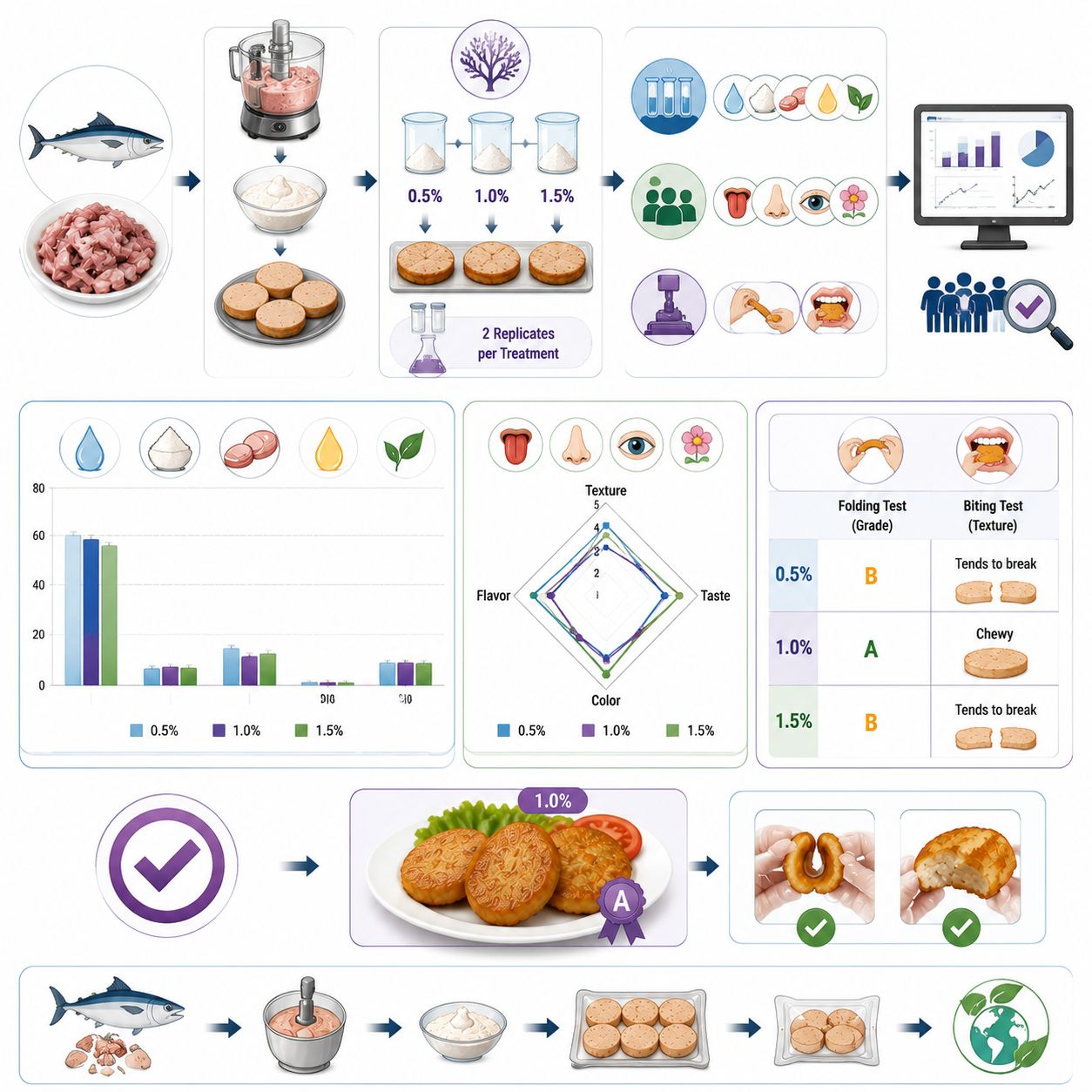
Tuna trim is a fishery by-product with potential for processing into surimi-based value-added products. This study evaluated the effects of κ-carrageenan concentrations (0.5%, 1.0%, and 1.5% w/w; two replications per treatment) on the proximate composition, sensory characteristics, and physical quality of tuna trim surimi patties. Proximate parameters, including moisture, ash, protein, fat, and crude fiber, were analyzed according to AOAC methods. Sensory evaluation was conducted using a 5-point hedonic scale for texture, taste, color, and flavor, while physical quality was assessed using folding and biting tests. Descriptive statistics were calculated for all parameters, and differences among treatments were analyzed using the Kruskal–Wallis test (α = 0.05) because the small number of replications did not meet the normality assumption required for parametric ANOVA. The results showed that carrageenan addition did not significantly affect any proximate or sensory parameter (p > 0.05). Moisture content ranged from 60.66–63.89%, ash from 1.88–1.94%, protein from 12.27–13.05%, fat from 0.145–0.207%, and crude fiber from 5.97–6.40%. Although the sensory differences were not statistically significant, the 1.0% κ-carrageenan treatment yielded the highest mean sensory scores and the best physical quality, achieving Grade A in the folding test and a chewy texture in the biting test. In contrast, patties containing 0.5% and 1.5% κ-carrageenan tended to break during physical testing. Therefore, 1.0% κ-carrageenan represents the most promising formulation for further development of tuna trim surimi patties.
References
AOAC International. (2016). Official methods of analysis of AOAC International (20th ed.). AOAC International.
Baek, S. I., & Cho, S. H. (2024). Dietary replacement effect of fish meal by tuna by-product meal on growth and feed availability of red sea bream (Pagrus major). Animals, 14(5), 688. https://doi.org/10.3390/ani14050688
Bixler, H. J., & Porse, H. (2011). A decade of change in the seaweed hydrocolloids industry. Journal of Applied Phycology, 23(3), 321–335. https://doi.org/10.1007/s10811-010-9529-3
Chen, J., Hu, Y., Gao, P., Jiang, Q., Yu, P., Yang, F., Pan, M., Zhou, X., & Xia, W. (2024). Effect of κ-carrageenan on the physicochemical and structural characteristics of ready-to-eat Antarctic krill surimi gel. International Journal of Food Science & Technology, 59(6), 3711–3722. https://doi.org/10.1111/ijfs.17113
Demedts, F., Reynvoet, B., Sasanguie, D., & Depaepe, F. (2022). Unraveling the role of math anxiety in students' math performance. Frontiers in Psychology, 13, 979113. https://doi.org/10.3389/fpsyg.2022.979113
Garofalo, S. F., Cavallini, N., Demichelis, F., Savorani, F., Mancini, G., Fino, D., & Tommasi, T. (2023). From tuna viscera to added-value products: A circular approach for fish-waste recovery by green enzymatic hydrolysis. Food and bioproducts processing, 137, 155–167. https://doi.org/10.1016/j.fbp.2022.11.006
Imeson, A. (Ed.). (2009). Food stabilisers, thickeners and gelling agents. Wiley-Blackwell. https://doi.org/10.1002/9781444314724
Kruskal, W. H., & Wallis, W. A. (1952). Use of ranks in one-criterion variance analysis. Journal of the American Statistical Association, 47(260), 583–621. https://doi.org/10.1080/01621459.1952.10483441
Lalopua, V. M. N., & Onsu, A. (2021). Karakteristik Kimia dan Organoleptik Kamaboko Surimi Tetelan Ikan Tuna. AGRITEKNO: Jurnal Teknologi Pertanian, 10(2), 74–82. https://doi.org/10.30598/jagritekno.2021.10.2.74
Lan, H., Chen, L., Wang, Y., Lu, M., Chen, B., Ai, C., & Teng, H. (2023). Effect of κ-carrageenan on saltiness perception and texture characteristic related to salt release in low-salt surimi. International Journal of Biological Macromolecules, 253, 126852. https://doi.org/10.1016/j.ijbiomac.2023.126852
Monto, A. R., Li, M., Wang, X., Wijaya, G. Y. A., Shi, T., Xiong, Z., Yuan, L., Jin, W., Li, J., & Gao, R. (2022). Recent developments in maintaining gel properties of surimi products under reduced salt conditions and use of additives. Critical Reviews in Food Science and Nutrition, 62(30), 8518–8533. https://doi.org/10.1080/10408398.2021.1931024
Park, J. W. (Ed.). (2005). Surimi and surimi seafood (2nd ed.). CRC Press.
Shaviklo, G. R. (2006). Quality assessment of fish protein isolates using surimi standard methods. United Nations University Fisheries Training Programme.
Wei, Q.-J., Zhang, W.-W., Wang, J.-J., Thakur, K., Hu, F., Khan, M. R., Zhang, J.-G., & Wei, Z.-J. (2024). Effect of κ-carrageenan on the quality of crayfish surimi gels. Food Chemistry: X(22), 101497. https://doi.org/10.1016/j.fochx.2024.101497
Xie, D., Tang, Y., & Dong, G. (2024). Various factors affecting the gel properties of surimi: A review. Journal of Texture Studies, 55(3), e12847. https://doi.org/10.1111/jtxs.12847
Yang, R., Juma, N. S., Zhao, Y., Zheng, B., Xu, Y., Gao, Y., Jia, R., Gao, P., & He, Y. (2025). Factors influencing surimi gelling properties and natural additive-based gel fortification strategies: A review. Comprehensive Reviews in Food Science and Food Safety, 24(1), e70067. https://doi.org/10.1111/1541-4337.70067
Yin, T., & Park, J. W. (2023). Comprehensive review: By-products from surimi production and better utilization. Food Science and Biotechnology, 32(14), 1957–1980. https://doi.org/10.1007/s10068-023-01360-8
Zhao, X., Mei, T., & Cui, B. (2024). Effect and mechanism of different exogenous biomolecules on the thermal-induced gel properties of surimi: A review. Journal of Food Science, 89(12), 10266–10282. https://doi.org/10.1111/1750-3841.17516
Copyright (c) 2026 Muh Kasim, Nurlaeli Fattah, Ida Astuti, Daniel Heintje Ndahawali, Rusli Rusli, Sri Wahyuni Firman, Endang Gunaisah

This work is licensed under a Creative Commons Attribution-ShareAlike 4.0 International License.
Copyright on articles was retained by the respective author(s) without restrictions. The author grants the journal its first publication rights with the work simultaneously licensed under the Creative Commons Attribution-ShareAlike 4.0 International (CC BY-SA) license. This means anyone is free to copy, transform, or redistribute articles for any lawful purpose in any medium, provided they give appropriate attribution to the original author(s).