System Dynamics-Based Assessment of Climate Resilience among Milkfish Aquaculture Households in Sibulue District, Bone Regency
DOI:
https://doi.org/10.47767/nekton.v6i2.1211Keywords:
aquaculture households, climate adaptation, resilience index, system dynamics, scenario analysisAbstract
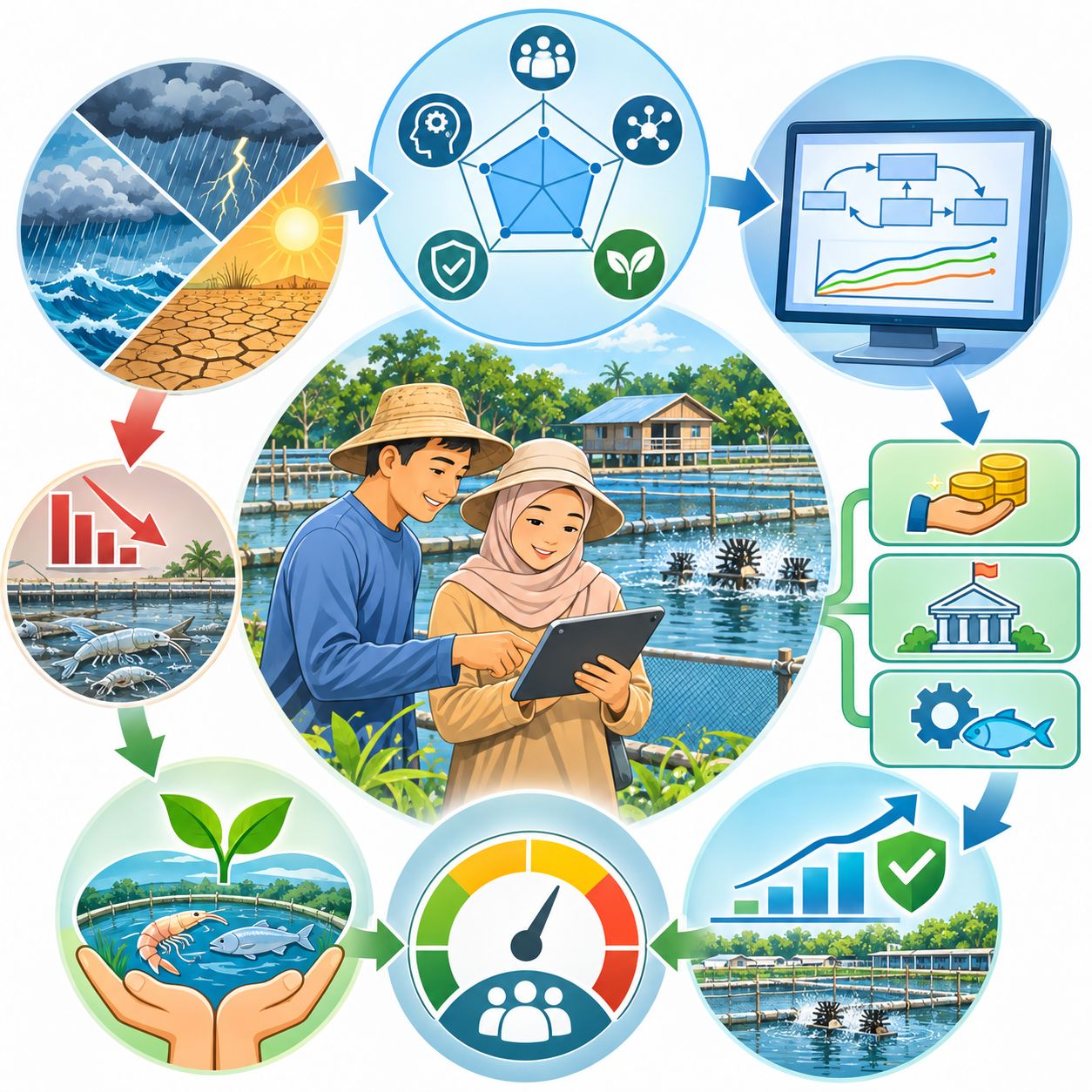
Climate change increasingly threatens aquaculture livelihoods through extreme weather events, seasonal variability, and production uncertainty, potentially undermining household resilience and enterprise sustainability. This study aimed to assess aquaculture household resilience to climate change and evaluate alternative adaptation policies using a System Dynamics approach in Sibulue District, Bone Regency, Indonesia. A mixed-methods approach was employed involving 30 aquaculture households. Quantitative data were analyzed descriptively to construct resilience indicators, while qualitative findings were used to identify key factors and relationships influencing household resilience. These findings were integrated into a System Dynamics simulation model developed using Vensim to evaluate alternative policy scenarios. The overall household resilience index was 53.87, indicating a moderately resilient condition. The resilience perception index was 54.38, while the dependency resilience index reached 60.25 and was classified as resilient. The climate change adaptation and recovery adaptation indices were 47.08 and 53.75, respectively, both indicating moderately resilient conditions. Simulation results indicated that alternative policy scenarios generated different projected trajectories of household resilience and aquaculture enterprise sustainability under changing climatic conditions. These findings highlight the importance of integrated adaptation strategies combining financial support, government intervention, and technical adaptation measures to strengthen aquaculture household resilience and sustainability. However, the simulated outcomes represent model-based projections rather than empirically observed policy effects.
References
Ahmad, M., & Wilkins, S. (2025). Purposive sampling in qualitative research: A framework for the entire journey. Quality & Quantity, 59(2), 1461–1479. https://doi.org/10.1007/s11135-024-02022-5
Badan Pusat Statistik Kabupaten Bone. (2024). Kecamatan Sibulue dalam Angka 2024. https://bonekab.bps.go.id/id/publication/2024/09/26/cbfd46771d062e0b37c12592/kecamatan-sibulue-dalam-angka-2024
Creswell, J. W., & Plano Clark, V. L. (2018). Designing and conducting mixed methods research (3rd ed.). SAGE Publications.
Cutter, S. L., Burton, C. G., & Emrich, C. T. (2010). Disaster resilience indicators for benchmarking baseline conditions. Journal of Homeland Security and Emergency Management, 7(1), Article 51. https://doi.org/10.2202/1547-7355.1732
Dinas Kelautan dan Perikanan Kabupaten Bone. (2024). Data produksi perikanan budi daya Kabupaten Bone Tahun 2024.
Fatahullah, Toiba, H., & Sujarwo. (2024). How does the shrimp farmer respond to the threat of climate change? HABITAT, 35(3), 235–249. https://doi.org/10.21776/ub.habitat.2024.035.3.21
Forrester, J. W. (1961). Industrial Dynamics. Waltham MA, Pegasus Communications.
Galappaththi, E. K., Ichien, S. T., Hyman, A. A., Aubrac, C. J., & Ford, J. D. (2020). Climate change adaptation in aquaculture. Reviews in Aquaculture, 12(4), 2160–2176. https://doi.org/10.1111/raq.12427
Gudbrandsdottir, I. Y., Oddsson, G. V., Stefansson, H., Olafsdottir, G., & Bogason, S. G. (2025). Towards a systems perspective in policy design: An analysis of how the endogenous feedback structure of the Norwegian salmon aquaculture industry impacts policy outcomes. Aquaculture, 598, Article 742045. https://doi.org/10.1016/j.aquaculture.2024.742045
Handisyde, N. T., Telfer, T. C., & Ross, L. G. (2017). Vulnerability of aquaculture-related livelihoods to changing climate at the global scale. Fish and Fisheries, 18(3), 466–488. https://doi.org/10.1111/faf.12186
Hossain, M. S., Zaman, B., Khan, M. A., Shihab, M. Y. K., & Nielsen, R. (2025). Impact of climate change and adaptation strategy in aquaculture: A systematic review. Aquaculture International, 33(5), Article 330. https://doi.org/10.1007/s10499-025-02013-9
Intergovernmental Panel on Climate Change. (2022). Climate change 2022: Impacts, adaptation, and vulnerability: Contribution of Working Group II to the Sixth Assessment Report of the Intergovernmental Panel on Climate Change. Cambridge University Press. https://doi.org/10.1017/9781009325844
Janmaimool, P., Nunsunanon, S., & Thamma-aphiphol, K. (2025). Aquaculture-related livelihood changes due to climate and non-climate stressors and well-being of residents in coastal communities. Environmental Challenges, 20, Article 101187. https://doi.org/10.1016/j.envc.2025.101187
Lestariaji, C., Anjasmara, A. S., Febriantoro, I., Poltak, H., Arif, D., Puspitasari, A. W., Yani, A., Tantri, A. F., Saidin, S., & Hasan, F. I. (2026). The effect of total suspended solids on phytoplankton abundance and water quality dynamics in intensive shrimp ponds in Kraksaan, Probolinggo, Indonesia. Nekton: Jurnal Perikanan dan Ilmu Kelautan, 6(1), 50–60. https://doi.org/10.47767/nekton.v6i1.1149
Muthoka, M., Ouko, K. O., Mboya, J. B., Ndambuki, M. N., Outa, N., Ogello, E., Obiero, K., Ogola, R. J., Midamba, D. C., & Njogu, L. (2024). Socio-economic impacts of climate change and adaptation actions among smallholder fish farmers in Sub-Saharan Africa. Aquaculture, Fish and Fisheries, 4(3), e182. https://doi.org/10.1002/aff2.182
Ochieng, S., Ogello, E., Obiero, K., & Cheserek, M. (2024). Determinants of households’ resilience to covariate shocks: Empirical evidence and policy implications from the Kenyan fisheries and aquaculture sectors. Aquaculture Journal, 4(3), 203–216. https://doi.org/10.3390/aquacj4030015
Pezi, Januardy, U., & Novita, U. D. (2021). Faktor-Faktor yang Mempengaruhi Pendapatan Petani Tambak Ikan Bandeng (Chanos chanos) di Dusun Sungai Mas Desa Sebatuan Kecamatan Pemangkat [Factors affecting the income of milkfish (Chanos chanos) farmers in Sungai Mas Hamlet, Sebatuan Village, Pemangkat District]. Nekton: Jurnal Perikanan dan Ilmu Kelautan, 1(1), 9–17. https://doi.org/10.47767/nekton.v1i1.265
REDE Research Group, Ogando-Vidal, A., & Rodríguez-García, C. (2024). Methodology for the development of a climate change resilience index for mussel aquaculture in Galicia (Spain). Zenodo. https://doi.org/10.5281/zenodo.12800095
Suryadi, S., Merdekawati, D., & Januardy, U. (2021). Produktivitas Budidaya Udang Vaname (Litopenaeus vannamei) Tambak Intensif di PT. Hasil Nusantara Mandiri Kelurahan Sungai Bulan Kecamatan Singkawang Utara [Productivity of intensive Pacific white shrimp (Litopenaeus vannamei) farming at PT Hasil Nusantara Mandiri, Sungai Bulan Village, North Singkawang District]. Nekton: Jurnal Perikanan dan Ilmu Kelautan, 1(2), 53–63. https://doi.org/10.47767/nekton.v1i2.301
Yadav, N. K., Patel, A. B., Singh, S. K., Mehta, N. K., Anand, V., Lal, J., Dekari, D., & Devi, N. C. (2024). Climate change effects on aquaculture production and its sustainable management through climate-resilient adaptation strategies: A review. Environmental Science and Pollution Research, 31(22), 31731–31751. https://doi.org/10.1007/s11356-024-33397-5
Downloads
Published
Issue
Section
License
Copyright (c) 2026 Riskiyani, Sitti Normawati, Ahmad Zailan, Al Mualam, Rizka Maulidiyah Mas’ud

This work is licensed under a Creative Commons Attribution-ShareAlike 4.0 International License.
Copyright on articles was retained by the respective author(s) without restrictions. The author grants the journal its first publication rights with the work simultaneously licensed under the Creative Commons Attribution-ShareAlike 4.0 International (CC BY-SA) license. This means anyone is free to copy, transform, or redistribute articles for any lawful purpose in any medium, provided they give appropriate attribution to the original author(s).